
The Laminate Sheet Was $140. The Mistake That Ruined It Took Four Seconds
You measured twice.
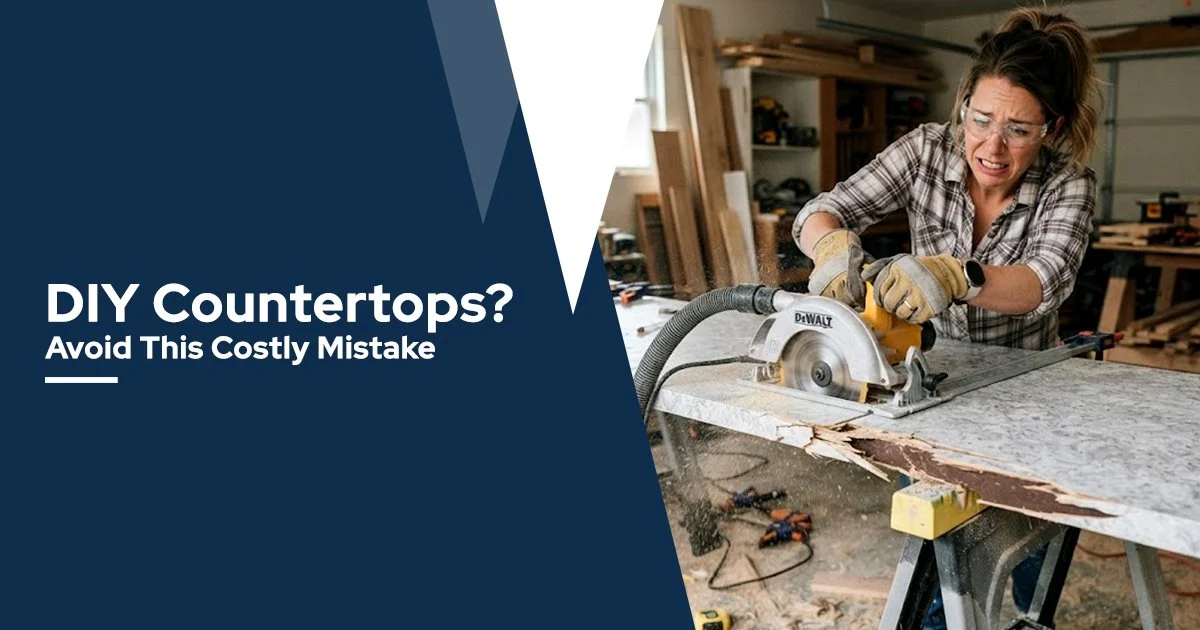
You marked the line carefully. You set the blade, lined it up, and pulled the trigger on the saw — and somewhere in that four-second cut, the laminate chipped along the decorative edge in a way that no amount of sanding was going to fix.
This is the moment that separates a smooth laminate countertop project from a frustrating one. Not the gluing. Not the trimming. The cut itself — and specifically, whether you made it with the right tool, on the right surface, with the right support underneath.
We've already walked Union and Franklin County homeowners through the full step-by-step process of cutting and installing laminate countertops and the precision techniques that produce a flawless finish. This post answers the question that usually comes up somewhere in the middle of that process: should you make this specific cut yourself, or bring it to us?
Why Is Cutting Laminate the Single Riskiest Step in a DIY Countertop Project?
Cutting laminate is the riskiest step in a DIY countertop project because the decorative top layer chips easily under an imprecise blade pass, and unlike most building materials, a chipped or mis-cut laminate sheet cannot be repaired invisibly — the only fix is replacing the section or living with the flaw.
Every other step in a laminate installation has some margin for correction. A slightly uneven bead of contact cement can be reapplied. A trim line that's a hair off can be sanded. A seam that needs more sealant can get more sealant.
The cut itself doesn't offer that margin. Laminate's decorative surface is a thin layer bonded to a core material — and that surface chips along the cut edge the moment the blade catches it wrong, runs too fast, or lacks the support underneath that keeps the material from flexing during the pass. Once that chip happens on a visible edge, there's no sanding it invisible. The sheet is compromised, and depending on where the chip occurred, you're either living with it or buying another sheet.
This is exactly why the precision matters more for laminate than for almost any other material a DIYer cuts in a kitchen project. A wood trim piece with a rough cut gets covered by molding. A drywall edge gets covered by joint compound. A laminate edge is the finished surface. There's nowhere for a mistake to hide.
Which Laminate Cuts Are Safe for a Confident DIYer to Make at Home?
Straight, full-length cuts on a stable, well-supported work surface — using a fine-tooth or carbide blade with the laminate properly taped and scored — are reasonably safe for a careful DIYer to make at home, particularly when the cut falls along an edge that will be covered by trim, end cap, or backsplash.
Not every cut on a laminate project needs to go to a saw table. Some are genuinely manageable at home with the right preparation.
A straightforward rip cut down the length of a panel — reducing a 5-foot sheet to fit a 4-foot run, for example — is a reasonable home project if you have a stable surface to support the full sheet during the cut, a sharp fine-tooth blade, and painter's tape along the cut line to reduce chipping. The cut is long, the blade path is predictable, and there's no curve or notch to navigate.
Cuts that fall on an edge that will be hidden — the back edge against a wall, an edge that will be covered by an end cap — carry lower stakes. If a small chip happens on an edge you're about to cover anyway, the mistake disappears under the trim piece.
The home-safe category narrows considerably the moment a cut becomes a finished, visible edge with no covering planned, or the moment it requires precision beyond what a handheld saw reliably delivers.
Which Cuts Should Go to a Panel Saw or Router Table Instead of a Handheld Tool at Home?
Full sheet cuts on large 4x8 or 5x12 panels, any cut that will remain a visible finished edge, sink and cooktop cutout corners, and any angle or curve beyond a simple straight line are the cuts where a panel saw or router table produces meaningfully better and more reliable results than a handheld circular saw or jigsaw at home.
Large panel cuts are the first category worth reconsidering. A full 4x8 or 5x12 laminate sheet is unwieldy to support evenly on a typical home work surface — sawhorses and plywood don't provide the consistent backing that prevents flex during a long cut, and flex during the cut is exactly what produces chipping. A panel saw holds the full sheet flat and supported across its entire length, which is the single biggest factor in a clean cut on large material.
Visible finished edges deserve the most caution. If the cut you're about to make will be the permanent, visible front edge of your countertop — the edge guests will see and your hand will run along for the next decade — that's not the cut to practice technique on. A router table with a flush-trim bit produces a clean, consistent edge that a handheld router pass, done once, under time pressure, in a kitchen that's currently torn apart, rarely matches.
Sink and cooktop cutouts involve interior corners where stress concentrates. A jigsaw blade navigating a tight interior corner is more likely to catch and chip than a router following a template on a stable table. These cutouts are also the cuts where a mistake is most expensive — you're cutting into the middle of a sheet you've already invested time and material into, with no second chance if the corner chips.
Any curve or compound angle — an angled peninsula edge, a radiused corner — benefits enormously from router table precision versus a freehand jigsaw pass.
How Does Hall Brothers' In-Store Cutting Actually Work for a Union, MO DIY Project?
Bringing your measurements or template to Hall Brothers Lumber lets our staff cut your laminate sheet on a panel saw and router table — the same equipment that produces clean, square cuts and finished edges that handheld tools struggle to match at home — while you still handle the gluing, fitting, and finishing yourself.
This isn't an all-or-nothing decision. Most successful DIY laminate projects in Union and Franklin County combine both approaches — professional cutting for the parts that matter most, DIY assembly and installation for everything else.
Bring us your cabinet measurements or a template made from your old countertop. We'll cut your laminate sheet on our panel saw for clean, perfectly square panel dimensions, and use our router table for finished edges that come out consistent on the first pass — no chipping, no flex, no second sheet needed because the first attempt went wrong.
You take the precisely cut pieces home and handle the contact cement, the bonding, the trim work, and the final installation yourself — exactly as covered in our full installation walkthrough. You keep the satisfaction and the savings of doing the project yourself. You skip the single step where an expensive sheet is most likely to be ruined by a tool and a technique that aren't quite matched to the job.
For most Union and Franklin County kitchens, this combination — professional cutting, DIY everything else — produces the best outcome for the least total cost. You're not paying for a full installation. You're paying for the ten minutes of precision that protects the rest of your weekend's work.
What Does It Actually Cost to Have Hall Brothers Cut Your Laminate Versus Cutting It Yourself?
The cost of in-store cutting is modest relative to the cost of a replacement sheet — and for most homeowners, avoiding even one mis-cut on a $100 to $200 laminate panel makes professional cutting the more economical choice once the real risk of a DIY mistake is factored in.
The math that matters here isn't the cutting fee against doing it for free at home. It's the cutting fee against the cost of getting it wrong.
A standard laminate sheet sized for a typical kitchen run costs roughly $100 to $200 depending on the brand and pattern you choose. If a handheld cut chips the visible edge of that sheet, your options are living with the flaw on a surface you'll look at every day, or buying a second sheet and starting that cut over — at which point any money "saved" by cutting at home has already been spent twice over, plus the lost time.
Bring your measurements in before you start. We'll talk through which cuts genuinely make sense to bring to us and which ones you can confidently handle at home — there's no requirement to have us cut the entire project if only the visible edges and sink cutout actually need it.
FAQ
Can I bring just part of my laminate project to Hall Brothers for cutting, or does it have to be the whole sheet?
Just part of it. Many Union and Franklin County DIYers handle their own rip cuts and hidden edges at home, then bring us the sheet for the visible front edge cut, sink cutout, or any angled section. Tell us which specific cuts you want done and we'll work from your measurements or template.
Do I need a professional template, or can I bring my own measurements?
Either works. If you have an old countertop you removed, that's often the best template — bring it in and we can work directly from it. If you're working from new cabinets, your own careful measurements with cabinet dimensions and any sink or cooktop cutout locations marked is sufficient.
What's the difference between a panel saw cut and a cut I'd make with a circular saw at home?
A panel saw holds the full sheet flat and fully supported across its entire length during the cut, which prevents the flex that causes chipping on large laminate panels. A handheld circular saw on sawhorses can't match that consistent support, especially on long cuts — which is exactly where chipping risk increases.
Why does the router table produce a better edge than a handheld router?
A router table provides a stable, fixed guide for the bit to follow, producing a consistent depth and angle across the entire edge length. A handheld router pass depends on the operator maintaining perfectly even pressure and speed across the full cut — which is harder to do consistently, especially on a first attempt.
Is it worth bringing the whole project to Hall Brothers if I'm not confident with any of the cuts?
Yes — and that's a completely reasonable approach. Many first-time DIYers start by having us cut the full project and handle only the gluing and installation themselves, which still produces meaningful savings over a fully professional installation while removing the highest-risk step entirely.
How far in advance should I bring my measurements in before my installation weekend?
A few days' notice is helpful, especially if you need a specific laminate pattern ordered. For straightforward cuts from in-stock material, we can often turn around cutting quickly — call ahead and we'll let you know our current timeline.
Does Hall Brothers carry the laminate sheets themselves, or do I need to bring my own?
We carry laminate sheets from major brands including Formica and Wilsonart, along with the substrate, contact cement, edge banding, and finishing supplies covered in our installation guide. You can select your laminate, have it cut, and pick up everything you need for the rest of the project in one visit.
Does professional cutting eliminate the need to follow proper installation technique?
No. Precision cutting solves the cutting risk specifically. The gluing, trimming, sink cutout, and finishing steps still require the same careful technique we cover in our full installation walkthrough and precision finishing guide. Professional cutting removes one specific point of failure, not the entire project's learning curve.