
Bamboo vs. Composite: The Hottest Sustainable Decking Options for 2026
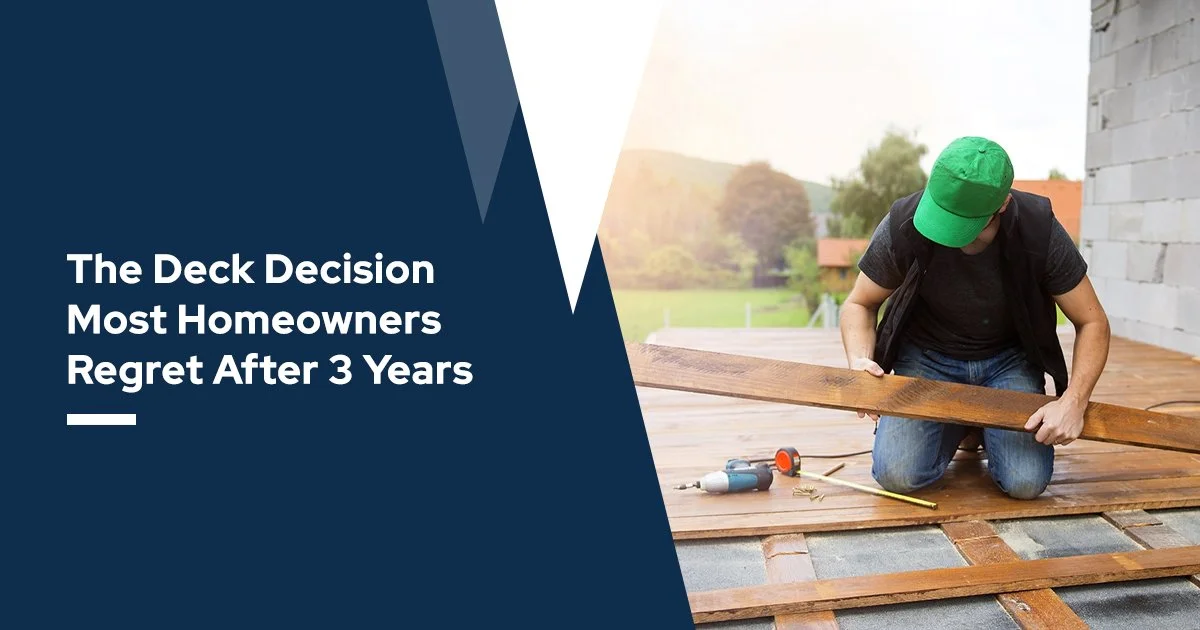
The Question Nobody Asks Until Year Three
Most homeowners spend weeks choosing the right deck. The shape, the size, the railing style. They compare prices, get a few quotes, agonize over the color stain.
Then three summers later, they're on their knees with a sander on a hot Saturday morning, refinishing boards that have gone grey and splintered rough — wondering why nobody told them this part was coming.
It's not that they made a bad decision. It's that they optimized for the upfront number instead of the full picture. And in 2026, with composite decking and sustainable decking materials having genuinely crossed the threshold from "interesting alternative" to "better product for most homeowners," that trade-off is worth understanding before you build — not after.
We've been helping families in Union, Washington, Pacific, and across Franklin County build their homes for 87 years. Here's the honest guide we walk every customer through when they're standing in our yard trying to figure out what's actually right for them.
What "Sustainable Decking" Actually Means — And What We Carry
The category gets used loosely, so it's worth being specific about what's actually available and what we stock.
Composite decking is the category most Franklin County homeowners are asking about right now. It's made from a blend of recycled wood fiber and reclaimed plastic — materials that would otherwise head to a landfill. The boards don't rot, don't splinter, and don't need annual sealing. The brands we carry at Hall Brothers — Trex, TimberTech, AZEK, Fiberon, and Envision — represent the full range of what's performing best in the market right now, from mid-range value options to premium capped composites with 25 to 30-year fade and stain warranties.
TimberTech, for example, is made from up to 73% recycled materials and saves tens of thousands of trees annually. Fiberon built its entire brand identity around eco-friendly manufacturing since 1997. These aren't marketing claims layered onto conventional products — sustainability is built into how these boards are made.
For homeowners who want the look and feel of natural wood without the maintenance overhead, Envision composite decking uses proprietary Compress Technology to create deep, non-repeating wood grain patterns that genuinely replicate natural wood character. It's one of the more visually impressive products we carry, and it holds up exceptionally well in Missouri's freeze-thaw climate cycles.
We also carry Deckorators for outdoor living spaces where the full design package — railing, balusters, post caps, and deck lighting — matters as much as the boards themselves. And for homeowners on the vinyl side, Missouri Vinyl Products offers maintenance-free decking and railing systems designed specifically for the Missouri, Illinois, and Arkansas market.
The Real Maintenance Comparison — With Actual Numbers
Here's the conversation most suppliers skip.
A standard pressure-treated pine deck in Missouri requires cleaning and resealing every one to two years to hold its appearance and resist the moisture and UV exposure our climate delivers. Cedar and redwood extend that maintenance cycle slightly but still need consistent attention — typically every two to three years. If you hire it out, expect $500 to $1,500 per maintenance cycle on a mid-size deck. If you do it yourself, it's a full weekend of work each time, plus materials.
A quality composite deck from Trex, TimberTech, or Fiberon requires essentially nothing beyond an occasional rinse. The color runs through the full thickness of the board — it's not a surface coating that weathers away. Most premium capped composite products carry 25 to 30-year limited fade and stain warranties. That's not a number we made up. That's what the manufacturers put in writing and stand behind.
Over a 10-year period, the maintenance cost difference on a 400 square foot deck can easily run $3,000 to $6,000 for a traditional wood deck versus near-zero for composite. That number changes the upfront cost conversation significantly.
The Upfront Cost Conversation — Honestly
Composite decking costs more per linear foot than pressure-treated pine. We're not going to pretend otherwise, because you'll see the difference the moment you compare product prices.
Pressure-treated pine runs roughly $2 to $4 per linear foot for decking boards. Quality composite boards — Trex Enhance, TimberTech Terrain, Fiberon Symmetry — run $4 to $10 per linear foot depending on the product line. Premium capped composite and AZEK products push higher.
On a mid-size deck of 400 square feet, the material cost difference between pressure-treated pine and a mid-range composite might be $800 to $2,000. Against a 10-year maintenance savings of $3,000 to $6,000 — plus your time — the math resolves itself fairly quickly for anyone planning to stay in their home in Franklin County for more than five years.
The scenario where traditional wood genuinely makes more financial sense is a short time horizon — if you're selling within two or three years and the upfront budget is the primary constraint. In that case, the lower material cost may outweigh the maintenance premium. We'll tell you that honestly too, because our goal is to help you make the right decision, not just sell you the most expensive product on the shelf.
What Missouri's Climate Does to a Deck
This is the piece that matters more than most homeowners realize before they've lived through it.
Franklin County sits in a climate zone that delivers genuine extremes — winters that push below zero, summers that exceed 100°F, high summer humidity, and significant spring rainfall. That combination accelerates wood degradation faster than almost any other climate type.
Freeze-thaw cycles are particularly hard on traditional wood decking. When moisture penetrates wood grain and then freezes, it expands, widening cracks and accelerating splitting. By the third or fourth year on an unsealed or under-maintained wood deck in this region, the surface wear is visible and the structural deterioration has already begun underneath where you can't see it.
Composite boards respond to Missouri's climate very differently. The material doesn't absorb moisture the way wood does, so freeze-thaw cycles don't create the same expansion-contraction stress. TimberTech's capped composite is specifically engineered to resist mold and mildew — which matters in our humid summers — and Trex products are designed for the UV exposure that Missouri's open-sky summers deliver.
If you're building a deck in Franklin County that you want to look good and perform well for the next 20 years, the climate case for composite is strong.
What the Deck Actually Feels Like to Live With
This part doesn't show up in spec sheets but matters every time you step outside.
Early composite decking from the late 1990s had a reputation for looking artificial and getting uncomfortably hot in direct sun. The category has changed substantially. Current capped composite boards use surface technology that significantly reduces heat absorption compared to older products, and the grain textures now replicate natural wood closely enough that most visitors to a well-built composite deck don't immediately identify it as composite.
The underfoot experience is slightly softer and more uniform than wood, which most users find comfortable — particularly barefoot on summer evenings. No splinters for children or bare feet. Better traction in wet conditions than smooth wood that develops surface algae after a wet Missouri spring.
One honest limitation worth mentioning: composite boards can show surface scratches from dragged furniture more visibly than wood, where the natural grain provides camouflage. Felt pads under outdoor furniture legs are a simple fix, but it's worth knowing before you buy.
The Questions That Actually Resolve the Decision
Rather than a generic checklist, here are the questions we walk customers through at the yard.
How long are you staying in this home? More than five years and composite almost always wins the financial calculation. Selling in two years and the upfront budget is tight? Pressure-treated pine may be the honest answer.
How much is your time worth on a Saturday? Two weekends a year on deck maintenance adds up. Price that honestly before defaulting to the lower material cost.
What's the deck's primary use? Heavy foot traffic, outdoor cooking, kids and pets daily — the durability gap between materials shows up faster under real use. A high-traffic deck in Union deserves a product that performs under that load.
What's your tolerance for variation? Natural wood has beautiful character and no two boards look identical. Composite offers consistency of color and texture that some homeowners prefer and others find less interesting than wood grain. This is genuinely a personal preference question, and we have samples of everything in our showroom so you can hold them side by side.
Why Installation Quality Matters as Much as Product Choice
The material decision only pays off if the installation is done right. Composite and capped composite boards have specific requirements around spacing, fastening systems, ventilation, and substructure that differ from traditional wood installation. We carry FastenMaster fastening systems specifically engineered for composite decking — hidden fasteners that eliminate visible screw heads and provide the correct spacing composite boards need for thermal expansion.
A composite deck installed incorrectly — wrong fastener spacing, inadequate substructure ventilation, improper board gapping — will underperform and may void the manufacturer warranty. If you're working with a contractor, make sure they have specific composite decking experience. If you're a confident DIYer, come talk to us before you start. We can walk you through the installation requirements for whatever product you're considering, and we stock everything you'll need from framing to fascia.
Come See the Products in Person Before You Decide
The best way to make this decision is to hold the products. We carry samples and display boards for Trex, TimberTech, AZEK, Fiberon, Envision, Deckorators, and Missouri Vinyl Products in our Union location. You can see the color options, feel the surface texture, and compare the weight and thickness of different product lines side by side.
We've been Franklin County's lumber yard since Stanley and John Hall started this business in 1938. Three generations and 87 years later, the same commitment applies — helping homeowners make decisions that serve them well for the next decade, not just the next season.
If you're planning a deck project this spring, come in and let's talk through what makes sense for your specific situation. And if you can't make it in, we offer free delivery across the area — call us at 636.583.2114 to discuss your project.
503 N Washington Street, Union, MO 63084
Mon–Fri 7am–5pm | Sat 8am–Noon
636.583.2114
hallbroslumber.com
Franklin County's Number One Lumber Yard — Trusted Since 1938