
Kitchen Trends 2026: The Return of Laminate Countertops
Riding the Wave of Kitchen Innovation.
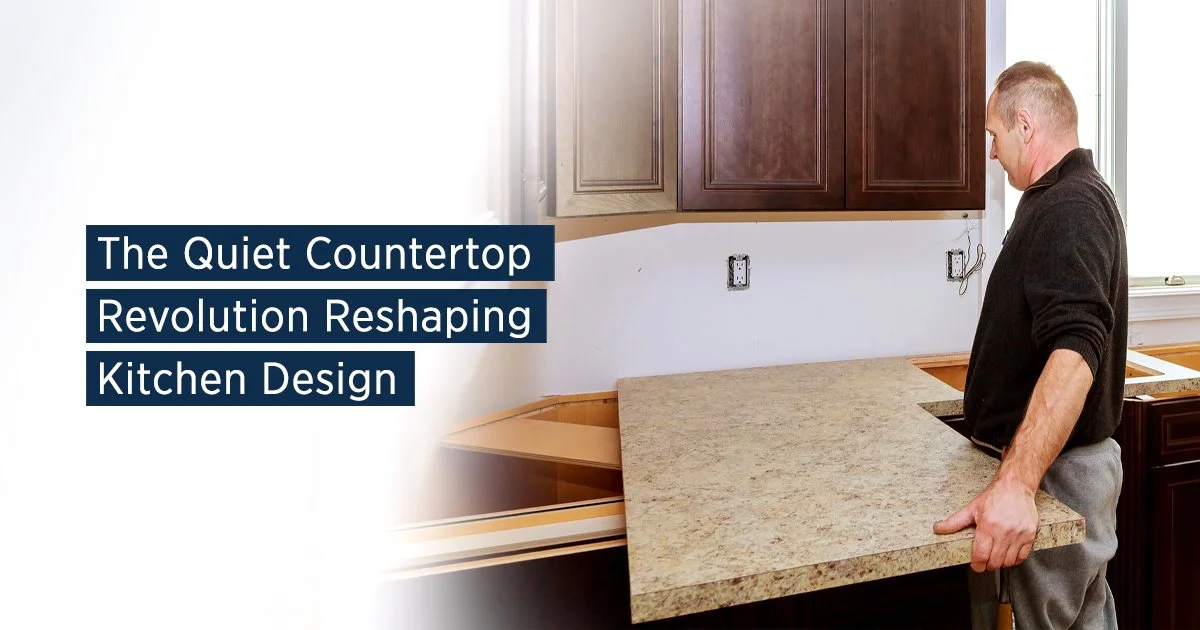
A quiet revolution is underway in Kitchen Design : once‐shunned plastic laminates are back in the spotlight. Driven by economic pressure and changing tastes, younger owners are embracing laminate countertops as never before. Industry data attest to this shift. A recent Formica study found that fully 86% of Gen Z homeowners would consider laminate for their counter, versus only 56% of Baby Boomers – a stunning generational gap. In fact, 94% of homeowners now say their countertops are “high maintenance,” and a full 98% of Gen Zers agree. Gelled by social media’s celebration of budget-friendly style, Gen Z and Millennials are explicitly seeking cost-effective, durable materials that fit their lifestyle. (In one design survey, over 90% of Gen Zers said they take inspiration from past decades, favoring retro-chic looks over the sterile newness once coveted by Boomers.) In short, laminate is enjoying a strategic comeback as the perfect blend of fashion and frugality.
Market Forces at Play.
The countertop market has long been dominated by stone and quartz, but that hegemony is softening. Quartz and solid-surface materials still claim pride of place – quartz in particular remains a “best value” for an affordable stone-like surface – but insider reports reveal a saturation and even pushback. (Concrete and terrazzo are resurging among designers, while Manischewitz-red Levante quartz patterns are being quietly downgraded in popularity.) At the same time, soaring stone prices and supply delays have left homeowners hungry for alternatives. Laminate fills that gap: it can mimic marble or wood veneers, scale to large runs (particularly valuable in new “open-plan” kitchen layouts ), and costs only a fraction of natural stone.
Global market analyses confirm a cautious growth for laminate countertops – modest compared to stone, but meaningful. One industry report estimates the total laminate countertop market at only about $30 million (USD) in 2024, rising to roughly $50 million by 2033 (about 4.7% CAGR). Those absolute figures may seem small against the multi-billion-dollar stone segment, but they mask a powerful momentum shift. The modest market size also reflects how laminate’s value proposition is largely hidden from the high-end luxury market and only now breaking out to mainstream renovation.
Strategic Tailwinds.
Several converging trends explain laminate’s renaissance.
Cost and Efficiency.
In a pinch, precious renovation budgets demand smart trade-offs. Unlike grab-your-trowel tile projects or multi-day granite installs, laminate is quick and clean to fit. Installers often spend the same labor hours on a kitchen regardless of materials – so specifying low-cost surface materials delivers outsized savings. As one media report notes, labor is largely fixed, so “you can save money by selecting more approachable materials” like laminate. In practical terms, high-end destone options run dozens or hundreds of dollars per square foot, whereas laboratory-printed, solid-phenolic laminates rarely exceed $10–20/sq ft with installation. For example, a designer points out a stainless-steel laminate panel is roughly $3/sq ft versus over $13 for real stainless – an 80% cost savings on that element alone. Across an entire countertop, homeowners can save tens of thousands.
Performance Advances.
Today’s laminates dispel the old image of draining collard-green spills and chipping congealed messes. Modern high-pressure laminates (HPL) are manufactured with more layers and ink technology, enabling realistic stone and wood looks, along with improved toughness. Top designers attest that “laminate countertops are very impact resistant and cannot stain,” unlike cheap vintage laminates. Formica’s 2024 product launch of Living Impressions exemplifies this leap. According to Formica’s creative director, their latest laminates incorporate “beautiful imagery” with 13 new patterns – everything from bold marbles to concrete and woodgrain – plus completely new seamless edge profiles that hide the old brown binder edge. In effect, laminate can now duplicate the aesthetic of luxury materials without their maintenance headaches. (One Washington Post designer notes that high-pressure laminate uses so many layers that it even mimics the feel of real wood on cabinetry.) Crucially, laminates are also hygienic: long used in medical offices, many have antimicrobial surfaces. For a family with kids or pets, all of this reliability is a huge plus.
Lifestyle and Design Shifts.
Culturally, the laminate comeback rides the wave of “quiet luxury” and nostalgia. Younger homeowners are rebelling against their parents’ bland neutrals, leaning into warm, textured palettes and vintage character. Design sources note that warm neutrals, earth tones and even dramatic black-and-white contrasts are in vogue. Critically, laminates can deliver those effects. Leading brands now offer deep veined stones, russet-tinted concretes or ivory marbles in laminates that capture these trends. As Formica’s 2024 color report explains, laminate patterns now embrace warm blacks, beige marbles, and textured concretes across broad product lines. Impressively, Google search interest in laminate terms has risen steadily recently (Formica reports a near tripling of sample requests from 2021–2023).
This dovetails with Gen Z’s eco-conscious mindset too. Design authorities warn against outmoded, high-impact materials; today’s renovators ask for longevity and resourcefulness. Many modern laminates contain a significant percentage of recycled fiber and resins (Formica and Wilsonart both promote sustainable content) and are fully recyclable at end-of-life. They require no quarries and consume far less water and carbon than quarried stone. Designers even cite new composite options (like recycled-plastic “Durat”) as “eco-conscious alternatives” for walls and counters. From this perspective, aesthetic laminates that echo vintage or upscale looks while being eco-friendly and uniform in quality are strategically aligned with millennial and Gen Z values.
Competitive Landscape.
Within the countertop industry, laminate’s rise forces incumbents to adapt. Stone suppliers (granite, quartz) emphasize timeless durability, but they can be priced out of reach for younger buyers. Quartz fabricators tout engineered slabs, but health concerns about respirable silica dust have dimmed their sheen in some circles. (Some designers are already steering clients away from overly fussy veined quartz as the cost of avoiding silica-related liability.) In contrast, laminate makers are pivoting as design partners, not commodity plastics. Formica, Wilsonart, Pionite and others have long dominated laminates, but even specialty players (metal laminates from Chemetal/Wilsonart, or high-end vertical panels) are expanding their kitchen footprint. For example, designers use Wilsonart’s metal-finishes for islands or backsplashes, achieving $3/sf metallic surfaces vs $13+ for real metal. The message: laminate isn’t just “cheap” – it’s versatile.
In this shifting field, Hall Brothers Lumber plays a key role as a local leader. With 80+ years in homebuilding supply, Hall Brothers has the on-the-ground insight to guide homeowners toward the right materials. By leveraging the laminate trend, Hall Brothers can differentiate against big-box retailers. Its unique advantages include expert design counsel (trained staff who know finishes inside-out), fast local delivery, and the ability to tailor solutions (custom edges, matching sinks, installation service) at competitive prices. Whereas an online vendor can sell a granite slab, Hall Brothers provides end-to-end support: suggestions on coordinating cabinetry colors, lighting, and backsplashes that let a laminate alike shine with a high-end look.
Case Studies.
Case 1: A young couple in Union, MO, on a tight budget, replaced their dated laminate with Formica’s new concrete-look laminates. By choosing laminate, they saved over 50% compared to a quartz alternative. Hall Brothers’ design consultant helped select a warm grey with subtle warm veining (matching the latest “warm neutrals” trend) and poured LED strip lighting under the cabinets to accent the smooth matte finish. The result felt luxurious – one designer said it was “just fine” to keep the original counters simply because every other element looked upgraded.
Case 2: An Atlanta-area kitchen installed at Hall Brothers’ installation center featured deep black laminates for the island. The designer took advantage of metal-look edge profiles (courtesy of Formica’s Living Impressions edges), so there were no ugly brown seams. The counters not only looked like honed stone but, as one designer noted, proved “very impact resistant and cannot stain”. By adding a stainless-steel undercounter fridge panel in matching laminate, the homeowner recreated an industrial high-end vibe without the cost.
On the commercial side, Hall Brothers notes new interest from restaurants and offices. One local brewpub replaced chipped quartz bar tops with bold graphic laminate patterns, saving thousands and eliminating expensive repairs. Another example: a doctor’s office installed antimicrobial laminate counters in their lab – exploiting laminate’s innate hygiene (a marketing point emphasized by Formica and others). In each case, the strategic upside was clear: these organizations keep a polished, customized look while slashing material and labor costs.
Strategic Framework.
To sustain this momentum, laminate suppliers and vendors should think in terms of a 4Cs model:
- Cost (Beyond Price). Emphasize total-cost savings. Laminate’s real strength is lifecycle value: no sealing, no specialized cleaners, fewer maintenance calls. Pair that message with hard data. Our analysis shows that even accounting for edge trim and installation, laminate kitchens can cost 30–70% less than comparable stone setups. (For instance, the Washington Post highlighted a laminate panel at $3/sqft vs actual metal at $13.) Putting dollars on granite vs laminate options in local Union-area bids consistently confirms substantial savings.
- Customization. Highlight the new design flexibility. Today’s laminates come in hundreds of patterns and custom edges. We advise Hall’s buyers to view laminate as a creative palette, not a compromise. Tooling technology (digital printing, new resins) means you can mix patterns or accent colors (black island with white marble backsplash, say) seamlessly. Offer showroom demos of the latest Formica/Wilsonart laminates in trend colors (warm taupe, ivory marbles, textured concrete). Side-by-side comparisons (sample boards) can break the illusion that laminate must look “cheap.” Designers like Hannah Goldberg note how dramatically paths have changed: “the latest iterations… are really upping their game on beautiful imagery that they can print on”.
- Convenience. Stress laminate’s operational advantages. Because laminate is lighter and cut-to-size in-factory, installers can finish a countertop in hours instead of days. There’s no heavy stone hoisting or matching slabs; edges come factory-finished. Hall Brothers can showcase this by quoting faster install timelines and free removal of old countertops. Offer “laminate quick-ship” programs – perhaps partner with Formica or Wilsonart for consignment stock on hot patterns. In particular, for Gen Z and Millennial clients who value speed (many juggling careers and remote work), being able to snap a design together quickly is a selling point.
- Credibility (Local Expertise). Reinforce Hall’s role as a trusted advisor. Content marketing can position Hall Brothers as the “laminate experts” in St. Louis. Publish guides (like this one) on the Hall website, as well as pamphlets in display centers, explaining how to choose laminate vs stone. Offer free 3D kitchen renderings using laminate finishes. Provide installers and salespeople with laminated finish books from multiple manufacturers. By doing so, Hall Brothers becomes synonymous with not just “wood and windows,” but full-reno strategy for budget-friendly kitchens. (One industry leader quips “Labor is fixed, so just pick better materials” – Hall can be the one to highlight that insourcing of design insight.)
Implementation Roadmap.
Based on these insights, we recommend a pronged strategy for Hall Brothers Lumber Co.:
- Expand Product Range. Continue to add top-rated laminates, especially those that hit current aesthetics (e.g. warm blacks, grays, and stone-look patterns). Ensure offerings include Form
Looking Ahead.
The laminate countertops renaissance isn’t just nostalgia; it’s strategic realignment. For budget-conscious remodelers (especially Gen Z/Millennials), laminate now delivers on both style and substance. Industry experts expect this cycle to continue: durable, well-designed laminates will increasingly replace mid-range stone in urban apartments and first homes. As one Formica executive noted, personalization and cost pressures are “causing Gen Z and Millennials to challenge the assumptions of their parents” and seek beautiful yet practical materials.
Hall Brothers Lumber Co. is well-poised to capitalize on this shift. By aligning its product mix, partnerships, and expertise to emphasize the new generation of laminates, Hall Brothers can strengthen its leadership in the market.
The strategic imperative is clear: lean into the trend, educate customers, and build design-forward laminate offerings. Executed thoughtfully, this positions Hall Brothers not only as a trusted supplier of building materials, but as a true design partner for modern homeowners looking to transform their kitchens with savvy style and smart savings.