
The Quality Grade System That Prevents $67,000 Material Failures
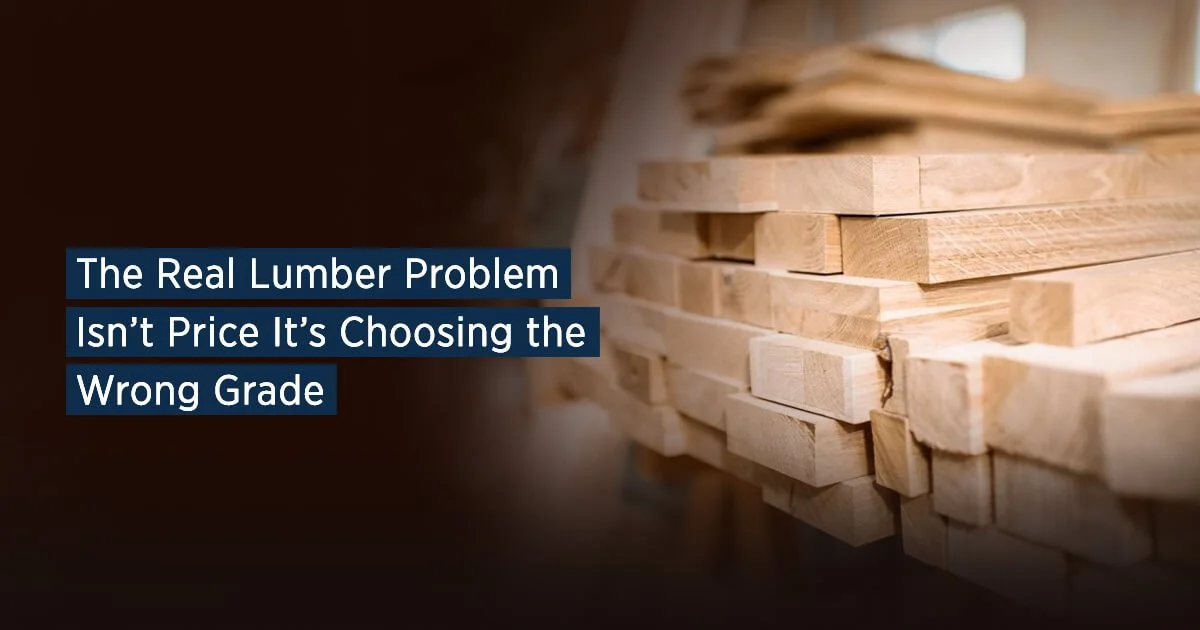
When people talk about lumber problems, the focus is usually on price swings. Builders remember the pandemic years, the sudden spikes, and the uncertainty. But price volatility is not the issue that quietly costs the construction industry the
most money.
The bigger problem is simpler and far more common: lumber grades being misunderstood, misapplied, or assumed to be interchangeable when they are not.
At Hall Bros Lumber, we see this regularly. Materials meet code on paper, but performance issues appear later—floors that feel soft, framing that moves more than expected, finishes that crack, or structures that require reinforcement sooner than planned. In many cases, the lumber was not “bad.” It just wasn’t the right grade for the job.
The Real Cost of Getting Lumber Grades Wrong
When the wrong lumber grade is used, the loss rarely shows up immediately. The structure stands, inspections pass, and the project moves forward. The cost appears later through callbacks, repairs, customer complaints, and lost reputation.
Industry studies estimate that material waste and rework cost residential construction billions every year. A significant portion of that comes from structural lumber that technically meets minimum requirements but does not perform well over time.
We have seen situations where a small saving at the material stage leads to large downstream costs. A floor system framed with lower structural grades may carry load, but excessive deflection can create bounce, drywall cracking, door misalignment, and long-term dissatisfaction. What looked like a cost-saving decision becomes a performance problem that is far more expensive to fix later.
Why Lumber Grades Cause So Much Confusion
Lumber grading was originally created to protect safety and standardize quality. Over time, it has grown increasingly complex. Today, there are hundreds of recognized grades across species, regions, and grading agencies, many with small but meaningful differences in strength and stiffness.
The challenge is that most lumber is purchased by name and dimension, not by engineering properties.
Two boards that look identical can have very different allowable stress values depending on grade, region, and species. Without understanding those differences, buyers naturally default to price.
Regional grading rules add another layer of confusion. The same species graded in different parts of North America can carry different structural values. Unless the buyer understands how those rules work, it is easy to assume performance is uniform when it is not.
Grades Are Not Just Labels — They Are Performance Indicators
Every structural grade exists for a reason. It defines how much load a piece of lumber can safely carry, how much it will deflect under stress, and how it will behave over time.
Higher grades are not automatically better for every application, but they matter when span, spacing, and long-term performance are critical. Lower grades can be perfectly suitable in many situations, especially where spans are short and loads are modest.
Problems arise when grade selection is driven only by availability or cost, rather than by application. That is where projects drift from “code-compliant” into “performance-risk territory.”
Species Choice Matters More Than Many Realise
Not all wood behaves the same way. Species selection is just as important as grade.
Southern Pine is strong and widely used for structural framing, but it behaves differently from Douglas Fir. Douglas Fir is dimensionally stable and performs well in framing, but it is not ideal for every exposure or application. Eastern White Pine is easy to work with and excellent for trim, but it is not designed for structural loads.
Each species has different stiffness, strength, and durability characteristics. When species and grade are mismatched to the application, performance suffers even if the lumber looks fine at delivery.
Short-Term Savings vs Long-Term Performance
One of the most common mistakes in construction is focusing on first cost instead of total cost. Saving money on lumber grades can reduce the invoice amount, but it can also increase labor, reduce spacing flexibility, and introduce long-term performance risks.
In some cases, using a higher structural grade allows wider spacing, fewer members, and better overall performance. When labor, material efficiency, and future repairs are considered together, the higher-grade option often costs less over the life of the project.
Good lumber selection is not about buying premium grades everywhere. It is about using the right grade where it actually adds value.
What Better Lumber Decisions Look Like
Projects that perform well over time usually have one thing in common: material choices were made intentionally.
The builder understood span requirements, loads, and exposure. The grade matched the structural need. The species was appropriate for the environment. The supplier communicated clearly about what was being delivered, not just what was ordered.
This approach reduces callbacks, improves customer satisfaction, and protects margins in the long run.
How Hall Bros Lumber Supports Smarter Material Choices
At Hall Bros Lumber, our role is not just to supply materials, but to help customers choose them wisely. We work with contractors and builders who care about performance, not just price.
That means helping clarify grade differences, explaining where upgrades matter and where they do not, and ensuring the material delivered matches the application it is intended for.
Lumber grading does not have to be confusing. When it is understood, it becomes a tool—not a risk.
A Final Thought
Most construction problems are not caused by dramatic failures. They are caused by small decisions that seemed reasonable at the time.
Lumber grades fall squarely into that category. They are easy to overlook, easy to assume, and expensive to misunderstand.
Better projects start with better material decisions. Understanding lumber grades is part of building structures that last, perform well, and protect your reputation long after the job is finished.
If you have questions about lumber grades, species selection, or material suitability for your next project, speak with the team at Hall Bros Lumber. Clear information upfront is always cheaper than fixing problems later.